
2016
next: 2017
Sisyphus of the Ear
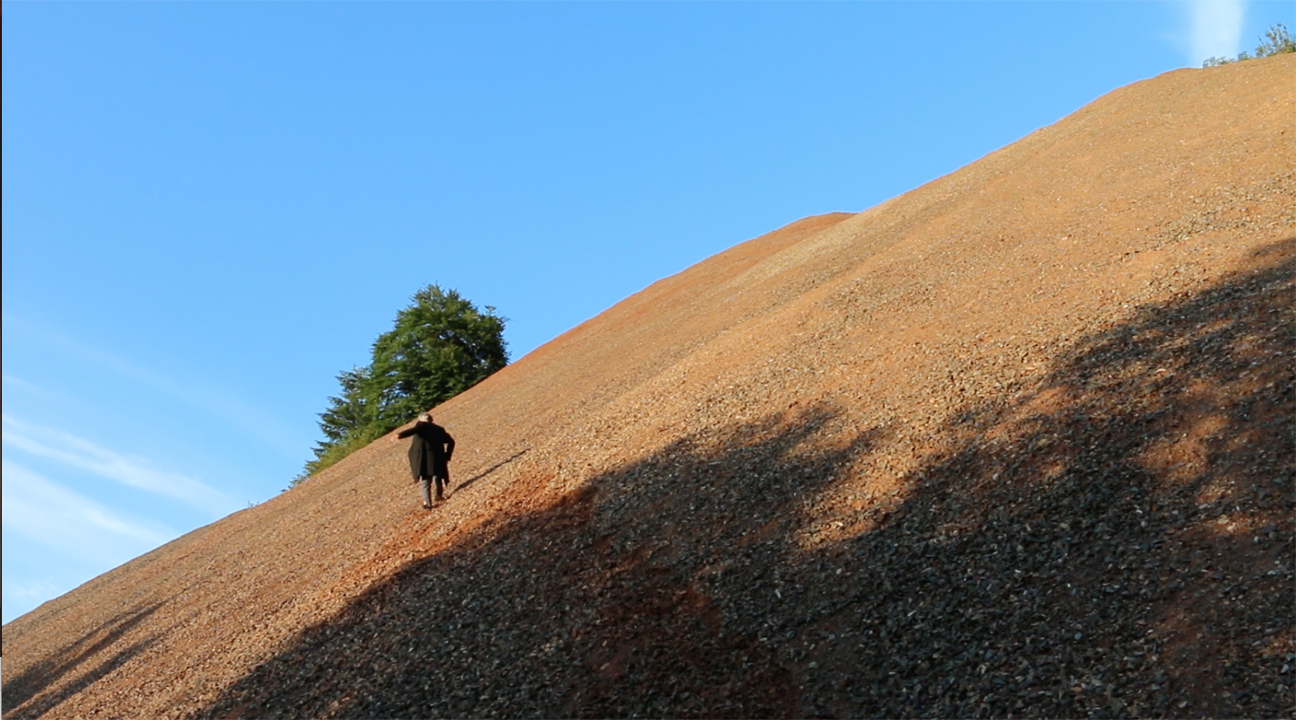
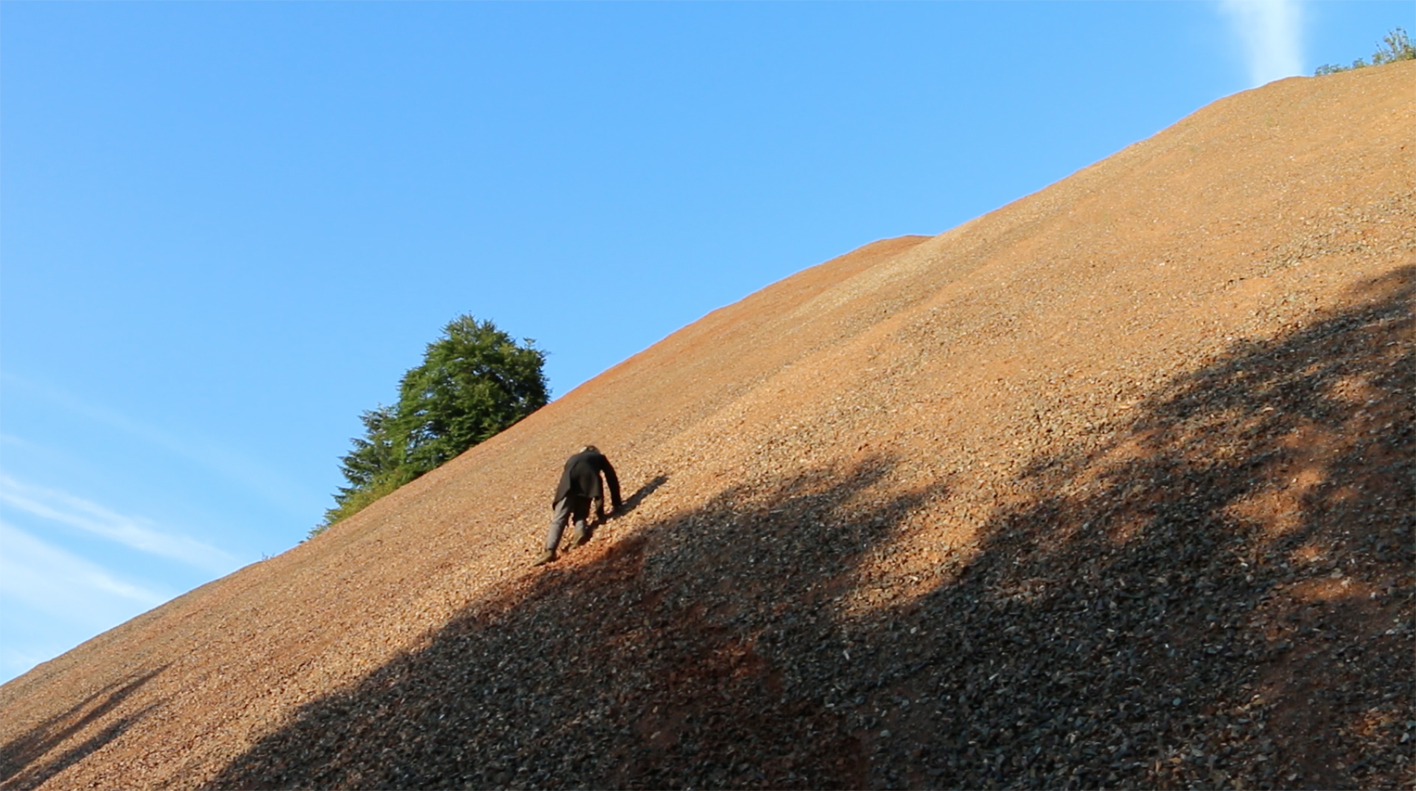
Sisyphus of the Ear © 2016 Birringer
Percussion, electronics and film
Paulo C. Chagas (music)
Johannes Birringer (film)
Description
A near-silent film (with a soundtrack of breath and stones moving) portrays
an older man's protracted and dangerous climb up a steep hillside in an abandoned
quarry; the climb fails and the protagonist falls down and slides to the bottom,
to repeat the climb. The images compose a study of futility (and an existential
scenario indebted to Camus' story on Sisyphus where he speaks of it set being
against the "unreasonable silence of the world” (1955) here compounded
by a [not visible] condition of an " inner wind" (vestibular disorder,
tinnitus and hyperacusis). The audible conditions are meant to be kinetically
evoked and interpreted through the percussion instruments. The music indeed
is the protagonist as such, as the evolving spectrum of percussion and electronics,
composed by Paulo C. Chagas, constitutes a sonic architecture that behave
like a shamanic force – seeming enacting its rhythms and atmospherics,
carimbó gestures with the force of an ancient ritual.
Notes from the Composer
The basic elements are short music sequences that repeat themselves many times; but the sequences are composed in such a way that you don't perceive the reception and pure repetition but as an ambiguous event oscillating between stability and variation.
The second elements are "hits" or "strokes" that disrupt and interrupt the flow of the repeating sequence. These interruptions change the dynamic of the composition as they become more and more present.
The combination of repeating sequences and interruptions result in a polyphonic structure and layered "flows" coming back and forth and crossing each other, so that it opens up many possibilities for perceiving the events.
This idea of flux going back and forth is related to the myth of Sisyphus
(and Camus's writing on the myth of Sisyphus and the confrontation between
human need and the unreasonable silence of the world). I found some interesting
ideas in my research, which I am trying to explore:
"More recently, J. Nigro Sansonese, building on the work of Georges Dumézil,
speculates that the origin of the name "Sisyphos" is onomatopoetic
of the continual back-and-forth, susurrant sound ("siss phuss")
made by the breath in the nasal passages, situating the mythology of Sisyphus
in a far larger context of archaic (see Proto-Indo-European religion) trance-inducing
techniques related to breath control. The repetitive inhalation–exhalation
cycle is described esoterically in the myth as an up–down motion of
Sisyphus and his boulder on a hill".
(cf. https://en.wikipedia.org/wiki/Sisyphus#cite_note-19)
I like specially the relation between the myth of Sisyphus and the movements
of the body.
European Premiere (test performance) October 26, 2016 Arts@Artaud, LondonPreview performance
with Kalid Puentes and Johannes Birringer on percussion
World premiere: November 2016
October 30, Ufa
/ Bashkir (Russia) Bashkir State Philharmonic Society.
November 2, Moscow (Russia))
Hong Kong, November 5
Auditorio del CMMAS (Centro Mexicana para la Música y las Artes Sonoras) Morelia, Mexico, 23 März 2017;
“Audiovisual
Music IV”, Culver Center Riverside, California, 19 Mai 2017.
